

Water should never be allowed to choose its own path around a pool. When it does, it can leave slippery walking surfaces, wash out base material beneath pavers, stain concrete, and send debris straight into the pool. The best pool deck drainage solutions control runoff before those problems start, while fitting the deck material, yard grade, and Connecticut weather conditions.
For a new pool installation, drainage needs to be part of the design conversation from the beginning. For an existing pool, puddles, soil erosion, or water collecting near the house are signs that the drainage system deserves attention before a small issue becomes an expensive deck or foundation repair.
Why pool deck drainage matters in Connecticut
Connecticut pool decks deal with more than an occasional summer thunderstorm. Spring rain, snowmelt, freeze-thaw cycles, and heavy leaf debris can all put pressure on a poorly planned drainage layout. Water that repeatedly settles in one location can weaken concrete, shift pavers, and create ice hazards after temperatures drop.
Drainage also affects the pool itself. Runoff carrying mulch, grass clippings, soil, or fertilizer increases the cleaning and chemical work required to keep water clear. If surface water drains toward the pool shell, it may also contribute to higher groundwater pressure around an inground pool. That is one reason proper site preparation matters as much as the visible finish of the deck.
The goal is straightforward: create positive drainage that moves water away from the pool, the home, and other structures without sending it toward a neighbor’s property. How that is achieved depends on the layout of the yard and the type of deck.
Best pool deck drainage solutions for common layouts
There is no single drain that works for every backyard. A level lot with a poured concrete patio calls for a different approach than a sloped yard with a paver deck or a pool set near a retaining wall. The right system often combines grading with one or more collection points.
Proper deck slope
Slope is the first line of defense and should be built into the deck itself. A concrete, paver, or stone surface should gently pitch away from the pool and house so ordinary rainfall continues moving instead of pooling. The grade must be noticeable enough to drain but subtle enough that furniture remains stable and the deck feels comfortable underfoot.
This is especially important on large concrete decks. If a slab is nearly flat or has settled over time, water may sit in low spots even when a nearby drain is present. In some cases, correcting the slope through resurfacing, slab lifting, replacement, or a redesigned overlay is more effective than adding drains alone.
Channel or trench drains
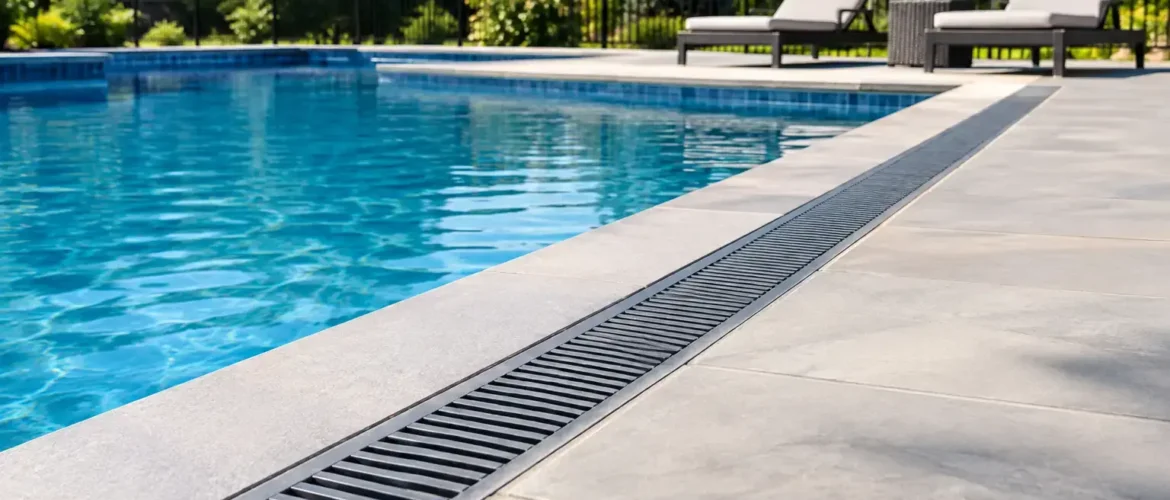
A channel drain is a long, narrow drain with a grate at the surface. It is one of the most effective solutions where a deck meets a house, a raised patio, a retaining wall, or another area that blocks natural runoff. Instead of allowing water to collect against that barrier, the channel captures it and directs it through underground piping to an approved discharge location.
Channel drains are a strong choice for concrete pool decks because they can be installed in a clean, continuous line and handle runoff across a broad area. They do require maintenance. Leaves, pine needles, mulch, and sunscreen residue can clog the grate and channel, so homeowners should inspect and clear them regularly during the swimming season and again before winter.
The outlet matters just as much as the drain itself. A channel drain that empties too close to the deck, foundation, or pool area simply relocates the problem. During planning, the drainage route should be designed around the property’s available grade and local drainage requirements.
Deck drains for paver and stone patios
Paver and natural stone decks have joints that allow some water to pass through, but that does not eliminate the need for drainage. Water still needs a stable, well-compacted base and a route away from the pool area. Without it, the base can wash out, individual pavers can settle, and the deck may develop uneven spots.
Depending on the design, a contractor may use discreet catch basins at low points, linear drains along an edge, or a permeable base system that directs water into a properly designed underground drainage bed. The best approach depends on soil conditions, the amount of runoff, and whether the patio has enough perimeter space to collect and disperse water.
For homeowners choosing pavers because of their appearance and repairability, this is worth discussing early. A beautiful paver deck is only as durable as the base and drainage beneath it.
Area drains and catch basins
Area drains, often called catch basins, collect water at specific low points. They are useful where runoff concentrates in a corner of the patio, at the bottom of a slope, or near landscaping that tends to hold water. A grated basin feeds into a buried pipe that carries water away from the pool deck.
These drains work well when the problem is localized. They are not usually the best standalone solution for a wide deck that sheds water along an entire edge. In that situation, a channel drain or changes to the deck slope may provide more dependable coverage.
Catch basins need periodic cleaning, particularly in wooded Connecticut yards. If the basin fills with sediment and leaves, the system loses capacity just when a hard rain puts it to work.
French drains for saturated soil
A French drain is designed primarily for groundwater and saturated soil rather than water running across the deck surface. It uses a perforated pipe surrounded by clean stone to collect water below grade and move it away from the area. This can be helpful near a pool where persistent wet ground, a hillside, or poor soil drainage creates pressure around the deck and landscaping.
French drains can be part of a larger pool drainage plan, but they should not be expected to solve every puddle on a flat concrete deck. Surface runoff needs surface drainage and correct slope. Subsurface water needs a system designed for subsurface conditions. Confusing the two is a common reason drainage projects fall short.
Swales and landscape grading
Sometimes the most effective drainage solution is not a visible drain at all. A swale is a shallow, gently shaped channel in the yard that guides water across the landscape and away from the pool area. When there is room on the property, grading and swales can reduce the amount of water that ever reaches the deck.
This approach can look natural and may cost less than installing extensive drain lines. However, it requires enough fall in the yard and careful planning around gardens, fences, sheds, and neighboring properties. It is often most effective when paired with a deck that already slopes correctly.
Match the drainage plan to your pool project
New pool construction gives homeowners the best opportunity to solve drainage before the deck is poured or pavers are installed. The excavation, pipe routes, finished elevations, patio footprint, and landscaping should work together. This is particularly valuable with an inground fiberglass pool, where access around the shell and the final grade of the surrounding deck should be planned as one system.
For a renovation, start by identifying where the water originates and where it goes during a hard rain. A puddle beside the pool may be caused by an incorrect deck pitch, a downspout that discharges too close to the patio, a blocked drain, or soil settlement beyond the deck. The visible wet spot is not always the source of the problem.
Homeowners should also think about winter service and long-term maintenance. Drain grates should be accessible, piping should be protected from damage, and discharge areas should not create a new icy or muddy section of the yard. A system that is difficult to clean is less likely to perform well over time.
Avoid drainage shortcuts that create bigger problems
Directing water toward the pool to get it away from the house is not a solution. Neither is adding a drain with no reliable outlet. Water needs a planned destination that works for the property, not a pipe that ends a few feet beyond the deck.
It is also risky to cover low spots with extra concrete or pavers without checking elevations. Raising one section may trap water elsewhere, create an awkward transition at coping, or interfere with gates and doors. Drainage changes should be evaluated as part of the full backyard layout.
At EZ Aqua Fiberglass Pools, drainage is considered alongside pool placement, decking, access, and the finished grade of the yard. A site evaluation can identify whether a deck needs a subtle slope adjustment, a linear drain, subsurface drainage, or a combination of solutions.
A dry, stable pool deck lets your family focus on using the backyard instead of working around puddles, mud, and slippery surfaces. Before committing to a new deck or repair, have the water path reviewed and build the solution around how your property actually drains.