

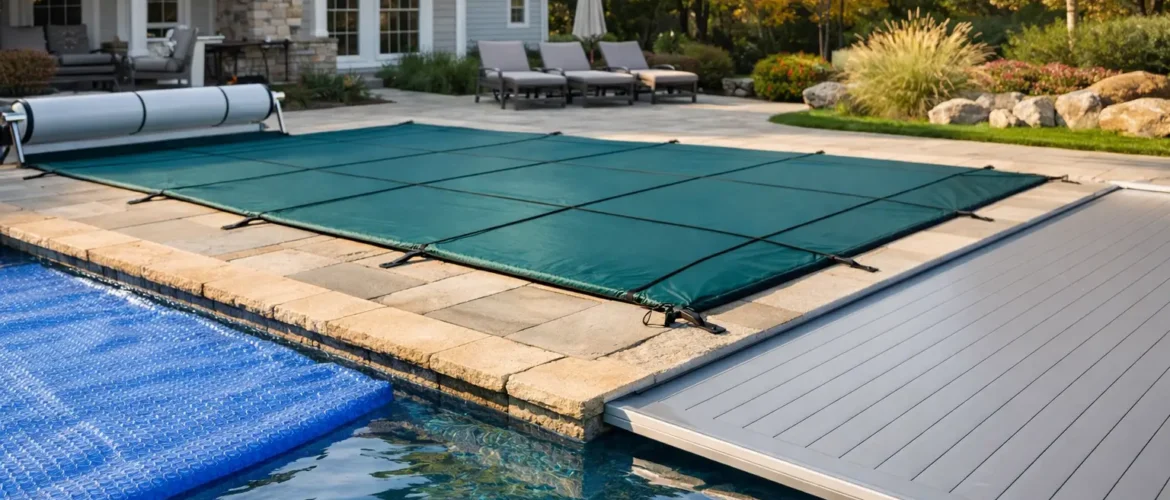
A pool cover is not just an accessory you pull out at closing time. The right choice can make your pool safer, reduce maintenance, limit heat loss, and help protect your investment through a Connecticut winter. With several pool cover types available, the best fit depends on how you use your pool, who has access to your yard, and whether your main concern is safety, heating costs, debris, or seasonal protection.
For many Connecticut homeowners, a fitted safety cover is the first option to consider. It is built for the realities of snow, wind, leaves, and a closed pool that may sit untouched for months. But it is not the only useful cover. Understanding where each option works well, and where it falls short, will help you make a practical decision.
Pool Cover Types and What They Are Built To Do
Each cover serves a different purpose. Some are designed to prevent accidental entry. Others preserve water temperature or keep leaves out of the pool. A cover that excels in one area may not solve another problem, which is why choosing based on price alone often leads to disappointment.
Safety Covers: The Best Fit for Most Connecticut Pools
A safety cover is anchored into the surrounding deck and stretched tightly over the pool. Properly installed covers are designed to support significant weight, helping prevent children, pets, and unauthorized visitors from falling into the water. For an inground fiberglass or vinyl-lined pool, this is usually the most dependable long-term winter-cover solution.
Safety covers come in two primary materials: mesh and solid. Both are custom measured to match the pool shape, steps, rails, raised features, and surrounding deck layout.
Mesh safety covers allow rain and snowmelt to drain through the material. Because water does not collect on top, they are generally easier to manage during the off-season and require less pumping. They are also lighter than solid covers, which can make seasonal installation and removal easier. The trade-off is that fine debris and sunlight can pass through the mesh. You may open the pool to water that needs more cleanup and balancing in spring.
Solid safety covers block sunlight and keep more dirt out of the pool. Less sunlight can mean less algae growth during the winter, often making spring opening cleaner. However, a solid cover needs a drainage system, such as a cover pump, because rainwater and melting snow remain on top. That pump requires occasional attention. If it fails or becomes clogged, standing water can become a problem.
For homes with children, pets, or nearby foot traffic, safety should lead the decision. A properly installed safety cover provides a level of protection that a standard winter tarp or solar blanket cannot match.
Winter Covers: Basic Seasonal Protection
Traditional winter covers are commonly made from heavy-duty vinyl or woven material and secured with water bags, cables, or other perimeter fasteners. They are often used on above ground pools and can be a lower-cost way to keep large debris out during the off-season.
These covers have limitations. They are not engineered as walk-on safety barriers, and they can sag under water, snow, or leaf buildup. Water bags can shift, tear, or lose water over time. On an inground pool, a loosely fitted winter cover can also allow debris to blow underneath the edges.
A standard winter cover can still make sense for an above ground pool or for a homeowner with a very specific budget. It simply should never be treated as a substitute for a safety cover. If a person or animal reaches the cover, the consequences can be serious.
Solar Covers: Heat Retention for the Swim Season
Solar covers, sometimes called solar blankets, are lightweight bubble-style covers that float directly on the water. Their main job is reducing evaporation and holding in heat. They can make a noticeable difference when cool nights are lowering water temperature, especially in Connecticut during late spring and early fall.
They also reduce water loss and can limit the amount of debris that reaches the pool. For homeowners who heat their pool, keeping the cover on whenever the pool is not in use may reduce heat loss and help control energy costs.
The limitation is simple: a solar cover is not a safety device. It does not support weight, and it should never be relied on to keep children, pets, or wildlife out of the water. It also is not designed for winter conditions. Heavy snow, ice, or wind can quickly damage it.
Many homeowners use a solar cover during the swimming season and switch to a custom safety cover at closing. A reel can make daily use more manageable, particularly for larger pools, but the reel needs room on the deck and should be factored into the layout.
Automatic Pool Covers: Daily Safety and Convenience
An automatic cover travels over the pool on a track system, opening or closing with a switch or key. It can reduce daily debris, slow evaporation, retain heat, and provide an additional layer of safety when it meets applicable safety standards and is used correctly.
Convenience is the major advantage. When covering the pool only takes a minute, homeowners are more likely to do it after swimming or before a storm. That can reduce skimming, chemical demand, and heat loss throughout the season.
Automatic covers require more planning and a larger upfront investment than manual covers. The pool design must be compatible with the cover system, and the track, housing, motor, and fabric need regular inspection and service. Pool shape, raised walls, water features, and deck design can affect feasibility. They are often easiest to plan during a new pool installation rather than after the fact.
An automatic cover is not always the right answer for every backyard, but it can be a strong option for homeowners who value everyday convenience and want to use their pool cover consistently.
Leaf Nets: A Helpful Add-On, Not a Standalone Cover
A leaf net is a lightweight net placed over a pool or, more often, over a winter safety cover. It catches leaves, acorns, twigs, and other fall debris before it lands on the primary cover. Once the trees are mostly bare, the net can be removed and stored.
This is particularly useful for wooded Connecticut properties. Removing a leaf net is much easier than trying to clear wet, decomposing leaves from a safety cover in November. It also helps prevent organic debris from staining the cover or ending up in the pool when spring arrives.
A leaf net does not provide safety protection or meaningful insulation. Think of it as a maintenance tool that can extend the usefulness of your primary cover.
How To Choose Between Pool Cover Types
Start with the season you are trying to solve for. If you need a winter closing solution, focus on a custom mesh or solid safety cover. If you are trying to keep the water warmer in July, a solar cover is more appropriate. If you want a cover that will be used almost every day, evaluate an automatic system.
Next, consider safety. A yard with young children, pets, visiting grandchildren, or easy neighborhood access deserves a purpose-built safety cover. This is not an area to compromise with a basic tarp-style winter cover.
Then look at maintenance expectations. A mesh safety cover drains well but may leave more cleanup for spring. A solid safety cover blocks more light and debris but requires a dependable pump and periodic checks. Solar covers need to be moved on and off frequently, while automatic systems need professional maintenance to keep tracks and mechanisms working correctly.
Your pool’s construction matters as well. Fiberglass pools, vinyl pools, and above ground pools all have different deck conditions, wall structures, and installation requirements. A custom cover should account for the exact pool shape, coping, steps, ladders, handrails, diving boards, and nearby landscaping. Measurements that are even slightly off can affect fit, drainage, and safety.
Do Not Overlook Professional Installation
A quality cover is only as dependable as its installation. Safety cover anchors need to be placed correctly in sound decking, tension needs to be set properly, and the cover must fit around every feature without leaving gaps. This is especially important on older pools with cracked concrete, uneven pavers, or decks that have been modified over time.
A local pool professional can inspect the pool area, explain whether mesh or solid material better fits your situation, and identify issues before ordering a custom cover. EZ Aqua Fiberglass Pools can help Connecticut homeowners evaluate cover options as part of pool installation, renovation, repair, or seasonal service planning.
The most useful pool cover is the one that matches the way your family actually uses the backyard. Choose safety protection for winter, heat retention for swim season, or daily convenience where it makes financial sense, then give the cover the same care you give the pool beneath it.
Pingback: Saltwater Pool Versus Chlorine Pool Compared - EZ Aqua Fiberglass Pools
Pingback: Pool Excavation Guide for Connecticut Homeowners - EZ Aqua Fiberglass Pools