

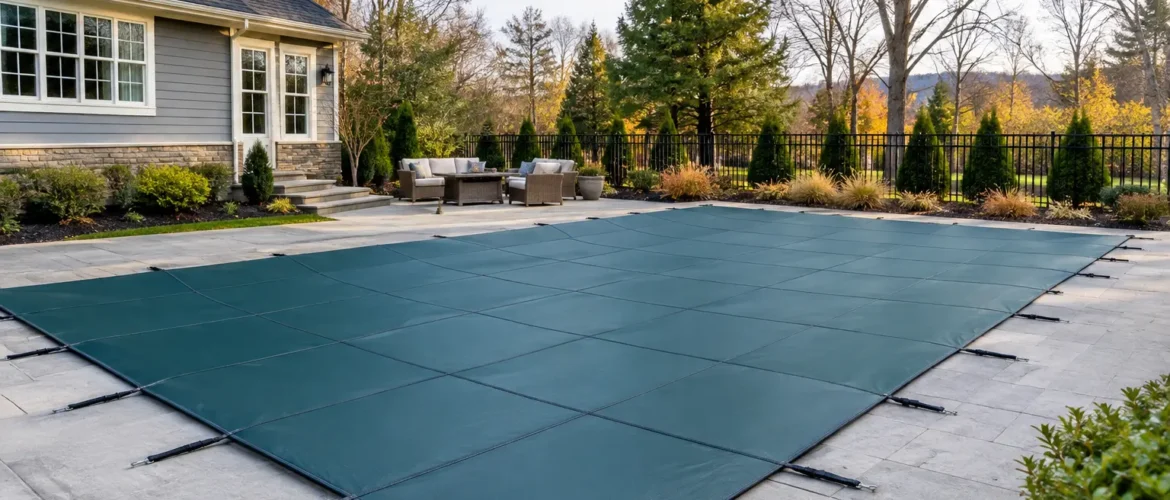
A pool can look completely calm in late fall, but an uncovered pool is not a closed pool. For Connecticut homeowners, safety covers create a physical barrier over the water when the swimming season ends. They help protect children, pets, guests, and wildlife while keeping leaves, branches, and storm debris out of the pool.
The right cover is not simply a tarp pulled tight across the water. A true safety cover is engineered to be anchored to the deck and tensioned over the pool. It should be sized and installed for your exact pool shape, surrounding deck, and site conditions. That difference matters when you are protecting a major backyard investment and the people who use it.
What Makes Pool Safety Covers Different?
A basic winter cover rests on the water or is held around the pool edge with water bags, cables, or weights. It can keep some debris out, but it is not designed to support a person or pet. If someone steps onto it, the cover can sink into the pool.
Pool safety covers use a network of high-strength straps secured to anchors installed in the deck. When properly tensioned, the cover spans the pool opening and is designed to resist accidental entry. Many quality covers are manufactured and tested to meet recognized pool safety performance standards, but homeowners should always confirm the rating and installation requirements for the specific product being considered.
That does not mean a cover replaces active supervision, fencing, gates, or other layers of pool safety. It does mean your closed pool has a much stronger barrier during the months when it is not in use.
Mesh vs. Solid Safety Covers
The best choice depends on what you value most: easier drainage and lighter handling, or a cleaner spring opening. Both cover styles can provide dependable protection when they are properly measured, installed, and maintained.
Mesh covers
Mesh safety covers allow rain and melted snow to drain through the material and into the pool. Because water does not collect on top, most homeowners do not need a cover pump. They are generally lighter than solid covers, which can make seasonal handling easier.
The trade-off is that fine dirt, pollen, and very small debris may pass through the mesh. The pool water may also need more cleanup at opening time. Higher-density mesh materials block more sunlight and debris than lighter mesh options, but no mesh cover keeps out everything.
For many Connecticut pool owners, mesh is a practical choice because it handles rain, snowmelt, and freeze-thaw cycles without standing water on the cover.
Solid covers
Solid safety covers block sunlight and keep nearly all debris out of the pool. Less sunlight can also limit algae growth, which may make spring cleanup easier. If your yard has heavy leaf drop or you want the cleanest possible opening, a solid cover deserves serious consideration.
The key consideration is water management. Rain and snowmelt remain on a solid cover, so the cover needs a properly maintained pump. A neglected pump or clogged drainage area can leave significant weight on the cover. Some solid covers include a center drain panel that allows water to pass through while still blocking most debris.
A solid cover can be an excellent long-term option, but it asks more of the homeowner during winter. If nobody will be checking the pool regularly, mesh may be the more convenient fit.
Why Custom Measurement Matters
Safety covers are not one-size-fits-all products. A rectangular pool with a wide concrete deck is relatively straightforward. A freeform fiberglass pool with steps, a raised spa, boulders, a diving board, or limited deck space requires much more careful planning.
The cover must extend beyond the pool edge so the straps can reach secure anchors. The installer also needs to account for the location of coping, deck joints, handrails, ladders, and nearby landscaping. On a fiberglass pool, the cover is anchored in the surrounding deck, not into the pool shell itself.
Deck material affects the installation as well. Concrete is often ideal for recessed brass anchors. Pavers may require anchors that work with the paving system and its base. Wood and composite decks need an appropriate fastening approach that considers framing and structural support. Every property is different, which is why accurate measurement is more valuable than trying to force a stock cover onto a custom pool shape.
Installation Details That Protect Your Investment
A safety cover works only when its straps and anchors are correctly installed. The cover should sit level, have even tension across its surface, and leave no easy gap at the edge. Straps that are too loose can allow sagging. Straps pulled too tight can put unnecessary stress on the cover, anchors, and deck.
Professional installation also helps prevent expensive mistakes. An anchor drilled in the wrong place is difficult to correct, especially in decorative concrete, stone, or paver patios. The layout should allow the cover to clear obstacles while preserving a clean appearance during the off-season.
At closing, the pool water should be lowered only to the level recommended for your pool and cover system. Draining too much water can create problems for certain pool types, particularly fiberglass pools, and can expose plumbing or surfaces to avoidable risk. Your closing plan should consider the pool structure, local winter conditions, equipment, and cover style together.
Care During the Connecticut Winter
Once a safety cover is installed, it still needs occasional attention. After a major storm, look for large branches, unusual sagging, loose straps, or standing water. Remove leaves and debris when it can be done safely from the deck. Never walk on a pool cover, even when it looks tight and supported.
For solid covers, check the cover pump and its discharge hose regularly. A pump that stops working during a rainy stretch can leave water building up quickly. For mesh covers, inspect straps and springs after heavy snow or wind. In either case, keep the area around the pool secured so children and pets cannot access the cover unsupervised.
Spring is also the right time to inspect the system before storing it. Clean the cover according to the manufacturer’s directions, allow it to dry fully, and look for worn stitching, frayed straps, damaged springs, or bent anchors. Addressing a small repair early is usually far less costly than replacing a cover after it fails.
When Is It Time to Replace a Safety Cover?
A quality cover can serve a pool for many years, but weather, UV exposure, chlorine, physical damage, and repeated tension eventually take a toll. Visible tears, stretched material, worn webbing, broken springs, missing anchors, and seams that are pulling apart all deserve professional attention.
Replacement may also make sense when you renovate the pool area. A new patio, expanded deck, added steps, or redesigned landscaping can change the anchor layout and leave an older cover fitting poorly. If you are replacing a liner, rebuilding an older pool, or upgrading a backyard around a fiberglass pool, it is a good opportunity to evaluate whether your current cover still fits the way you use the space.
Do not assume a cover is safe because it looks intact from a distance. The tension system, stitching, and anchor connection are just as important as the fabric itself.
Choosing the Right Cover for Your Pool
Start with the practical questions. Do you want water to drain through the cover, or would you rather block as much debris and sunlight as possible? Can you check a pump through the winter? What type of deck surrounds the pool? Are there raised features, special steps, or limited anchor space? The answers will point toward the right material and installation approach.
Price matters, but the lowest initial price is not always the lowest-cost decision. A properly fitted cover can reduce cleanup, protect the pool from heavy debris, and provide meaningful protection during the off-season. It should be treated as part of the pool system, not as an afterthought purchased at closing time.
EZ Aqua Fiberglass Pools can assess your pool, deck, and backyard layout to help identify a cover that fits correctly and performs through Connecticut winters. A well-fitted cover lets you close the pool with greater confidence, then spend less of spring dealing with problems that could have been prevented.